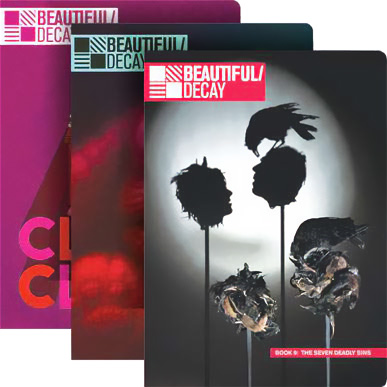


The work of artist Adel Abdessemed is at once direct and poetic. He often uses common imagery and objects as a point of departure. However, the mundane beginnings of these objects only further underscore the weighty nature of his art. Abdessemed’s installations are able to provoke a sudden impact of its viewer. Still, the installations communicate complex ideas that unfold over extended viewing. At times controversial, his work is effective in piquing thought and discussion.
With a toxic mix of oil-based paint, the surfaces of artist Claire Falkenberg‘s large-scale photos are transformed into mysterious and eerie clouds. The ominous, milky clouds obscure the space directly in front of the photographer, delaying the viewer’s ability to understand what lies just under the surface of each picture plane. This inclusion is generous, because it offers another layer of surface detail to the viewer who is willing to inspect the ghostly swirls of oil paint. The slick, snapshot-style images of trash slowly begin to reveal themselves—vanishing almost entirely at the center, and bringing into question just exactly what Falkenberg has chosen to cover up in her series.
Science never ceases to amaze us with its bizarre, powerful and sometimes even beautiful. Wim L. Noorduin, a postdoctoral fellow at the Harvard School of Engineering and Applied Sciences has managed to create tiny flower like sculptures out of crystals. Now crystals are commonly known for having hard jagged edges. However Noorduin’s crystals buck convention with their organic shapes that were created by manipulating chemical gradients in a beaker of fluid through a chemical reaction between Barium Chloride and Sodium Silicate. (via)
“For at least 200 years, people have been intrigued by how complex shapes could have evolved in nature. This work helps to demonstrate what’s possible just through environmental, chemical changes.” -Wim L. Noorduin as told to Caroline Perry
With your face close to Jacob Everett‘s ball point pen drawings, you’ll notice they look very similar to the endless swirling pen marks of a distracted mind. The kind of meaningless doodles we may do while speaking on the phone. If you zoom out, however, the doodles turn into detailed portraits of celebrities. For his Well Known Faces series, Everett painstakingly arranges the tiny swirls to create huge portraits. First, he sketches and graphs his subjects before layering them in swirls section by section. He says of his work:
“I am interested in the contrast between the minute, repetitive mark-making and the highly personal image that is created. The process is similar to mass production. I work from photographs, concentrating on one section of the face at a time. Over several shifts spent in this way, the work culminates in a finished product which is, paradoxically, an authentic and personal portrait.”


In a way, endlessness is a fundamental characteristic of gifs. However, the work of Turkish artist Erdal Inci, highlights this aspect of a medium in a style that is especially hypnotic and creepy. Inci has worked in video for nearly ten years. He’s since translated work into gifs using his same clone and light effects. In them, he seems to produce an endless hoodied army of himself marching, sliding down handrails, hopping up and down stairs. Though the action is brief, its repetitive nature makes it difficult to pull away your eyes. All of the Erdal Inci clones in lockstep trudge on together until we manage to close the window. [via]
Whether through painting, illustration, sculpture, or installation, Kenny Scharf displays an aesthetic saturated with bright colors and playful figures. Think: Pee Wee’s Playhouse + Keith Haring on acid. With his work, Scharf seamlessly integrates pop culture into fun and fluid forms. With his pop culture appeal, it’s no surprise that Scharf has been commissioned to do commercial work by companies such as Kiehl’s, Vans, and Swatch. While other artists might have a different viewpoint on commercial work, for Scharf, the opportunity to bring his playful forms into everyday products is of significant cultural value, “One very important and guiding principle to my work is to reach out beyond the elitist boundaries of fine art and connect to popular culture through my art,” Scharf writes in his artist statement.
Mike Leavitt’s Intuition Kitchen churns out a plethora of playful and multidimensional pieces. From portable homeless shelters to wedding cake toppers and DIY vending machines, his career in the creative world knows no boundaries and ignores all stigmas. He just grabs inspiration and goes for it. For instance, Leavitt pays homage to Christo by shaping his image from polymer clay, a staple at Michaels or any craft supply store. This, and other Art Army Action Figures, embrace a lovely contrast between materials and content in an loveable and pitch perfect manner. It’s not just cheap plastics imported from overseas factories, nor is it about elitism in the commercial art world, nor is it a rebellion against any of it. Each art star figurine is simply built from hand in a limited edition of 10 with a raw passion and appreciation for the entire spectrum.